
Van Anh Pham
Content Marketing
Distinguishing and Understanding: Machine Learning vs AI
5 minutes read
Audio description available
October 9, 2023
In the ever-evolving landscape of technology, the terms "Machine Learning" and "Artificial Intelligence" (AI) are often used interchangeably, causing some confusion. AI encompasses the broader idea of computers mimicking human thought and functioning in real-world settings. In contrast, Machine Learning, a subset of AI, employs algorithms to recognize patterns, make informed decisions, and learn from data. Join us to explore real-world applications of machine learning vs AI and uncover the unique advantages each offers in our rapidly advancing technological era.
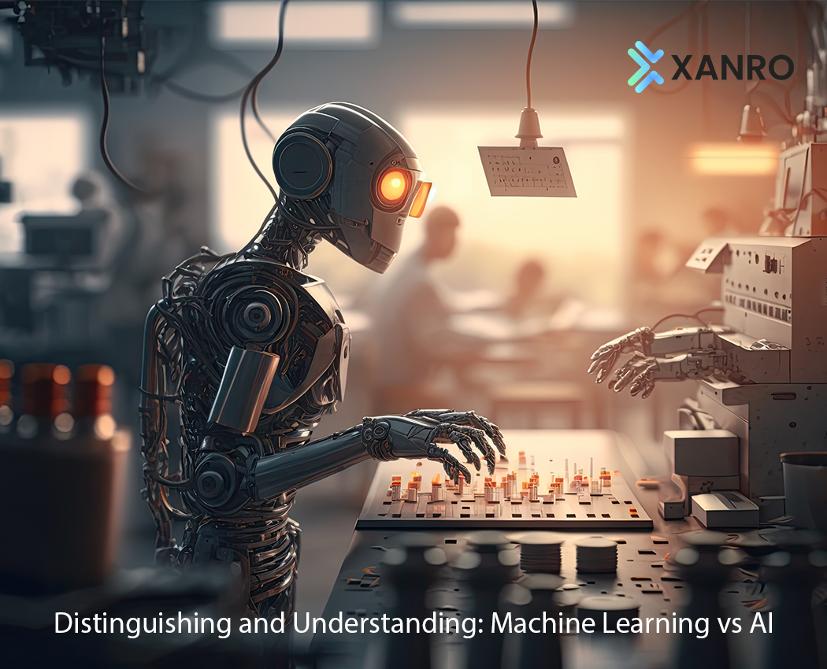
What is AI?
Artificial Intelligence encompasses a broad spectrum of technologies aimed at creating machines capable of mimicking cognitive functions associated with human intelligence. These functions include understanding and responding to language, analyzing data, making recommendations, and more. AI is not a standalone system but a set of technologies implemented to enable reasoning, learning, and problem-solving. Today, AI is integral to various technologies, including smart devices and voice assistants, transforming how we interact with machines and automating tasks.
What is Machine Learning?
Machine learning (ML) is a subset of artificial intelligence (AI) that equips machines to learn and improve from experience. Instead of explicit programming, ML employs algorithms to analyze vast datasets, draw insights, and make informed decisions. ML algorithms enhance their performance over time as they process more data, yielding better models. Machine learning is a pathway toward AI, using algorithms to automatically learn, recognize patterns, and make increasingly intelligent decisions.
How are Machine Learning vs AI Connected?
Understanding the connection between AI and machine learning is vital. AI systems are constructed using machine learning and other techniques. Machine learning models, created through data pattern analysis, are optimized by data scientists, enhancing their accuracy for specific tasks. This iterative process highlights the synergy between AI and ML.
AI encompasses the broader concept of enabling machines to mimic human capabilities, while ML is a specific application of AI that autonomously extracts knowledge from data. Think of AI as the umbrella term encompassing various subfields, with machine learning being one of them, alongside deep learning, robotics, expert systems, and natural language processing.

Critical differences between Machine Learning vs AI
When differentiating between Machine Learning vs AI, diving deeper into their distinctions is essential. Rather than merely listing the differences, let's explore them in a more engaging and informative manner:
Scope and Objectives
AI: AI has a broader scope, aiming to develop intelligent systems that can perform complex tasks, often involving reasoning, problem-solving, and mimicking human-like decision-making processes.
ML: In contrast, ML has a more focused objective. It seeks to train machines to perform specific tasks by identifying patterns in data and delivering accurate results. ML doesn't necessarily aim to replicate human intelligence but to optimize task performance.
Methods and Techniques
AI: The field of AI encompasses a diverse range of methods and techniques, including neural networks, deep learning, genetic algorithms, expert systems, natural language processing, and more. These methods are used to solve various problems and make decisions.
ML: ML, as a subset of AI, concentrates on two main approaches: supervised and unsupervised learning. In supervised learning, models learn from labeled data, while unsupervised learning explores unlabeled data to discover patterns. ML often employs statistical models for predictive analysis.
Applications
AI: AI finds applications in various fields and industries, from healthcare and finance to autonomous vehicles and natural language understanding. It's employed wherever complex, human-like decision-making is required.
ML: ML has a more limited scope of applications, focusing primarily on tasks that involve data analysis and pattern recognition. Typical ML applications include recommendation systems, predictive maintenance, and image recognition.
Complexity and Implementation
AI: Building AI products can be intricate, requiring significant resources and expertise. Developers may use prebuilt AI solutions that have undergone extensive research and development.
ML: ML solutions are typically easier to use, with different requirements depending on how complex the issue is. Although ML can require a lot of processing power, it is frequently possible to execute ML models on a single server or small cluster.
Integration and Prebuilt Solutions
AI: AI solutions often involve integrating prebuilt AI models and services into applications through APIs. These solutions are designed for tasks requiring human-like intelligence and reasoning.
ML: ML solutions may involve developing custom models based on specific data requirements. However, prebuilt ML functions are also available for integration via APIs, simplifying the implementation process.

Read more: 2023's Leading Machine Learning Models for Success
Benefits of using Machine Learning vs AI together
Machine Learning vs AI have seamlessly integrated into our daily lives, quietly enhancing various services and experiences. These transformative technologies find application across diverse sectors, showcasing their profound impact. Here, we explore real-world applications that highlight how companies effectively leverage AI and machine learning:
Healthcare
Healthcare has seen remarkable advancements through AI and machine learning, improving patient outcomes and operational efficiency. Key applications include:
Early cancer detection through machine learning image analysis.
Personalized treatment plan development.
Efficient hospital resource allocation.

Business
AI's transformative power extends to business, driving cost reductions through automation and providing actionable insights from extensive data analysis. A 2020 survey by NewVantage Partners revealed that 91.5% of companies are investing in AI, recognizing its disruptive potential.
Supply Chains
Complex global supply chains benefit from AI-enhanced digital solutions, ensuring seamless operations. These systems adeptly track shipments, predict potential delays, and troubleshoot issues in real-time, providing prompt deliveries and resilient supply chains.
Banking Efficiency with AI
In the banking sector, AI ensures data security and efficiency, detecting and preventing fraud, authenticating user identities, and automating customer service through chatbots and voice assistants.
Cross-Industry Applications
Organizations across diverse sectors embrace AI and ML to optimize processes, enhance decision-making, and elevate customer and employee experiences. Key applications include:
Manufacturing: Predictive maintenance and real-time production machine monitoring.
Ecommerce and Retail: Inventory optimization and personalized customer experiences.
Financial Services: Fraud detection and automated trading.
Conclusion: Transforming Data into Action
AI and machine learning are not mere buzzwords; they are transformative forces shaping our present and redefining our future. Whether enhancing healthcare, streamlining business operations, or fortifying financial transactions, these technologies continue to revolutionize our daily lives.
Do you wish to capitalize on the possibilities of machine learning vs AI? We can assist. Explore our services to gain access to a multitude of resources ranging from efficiently constructing ML solutions to seamlessly integrating prebuilt AI services into your projects.