
Van Anh Pham
Content Writer
Home > Blog > Machine Learning
Leveraging AI Image Recognition: Applications and Insights
5 minutes read
Audio description available
August 31, 2023
In the digital age, a staggering 2.5 quintillion bytes of data are generated daily, and a significant portion of this data consists of images. Visual content permeates our lives, from the photos we share on social media to the medical scans that aid in diagnoses. However, understanding and extracting meaningful insights from this visual deluge is an enormous feat.
This is where the transformative power of AI Image Recognition comes into play. It's the key to decoding the visual world, enabling computers to 'see' and understand images and videos. In this article, we explore the heart of AI Image Recognition, unraveling its inner workings and the myriad of real-world applications revolutionizing how we interact with the visual world.
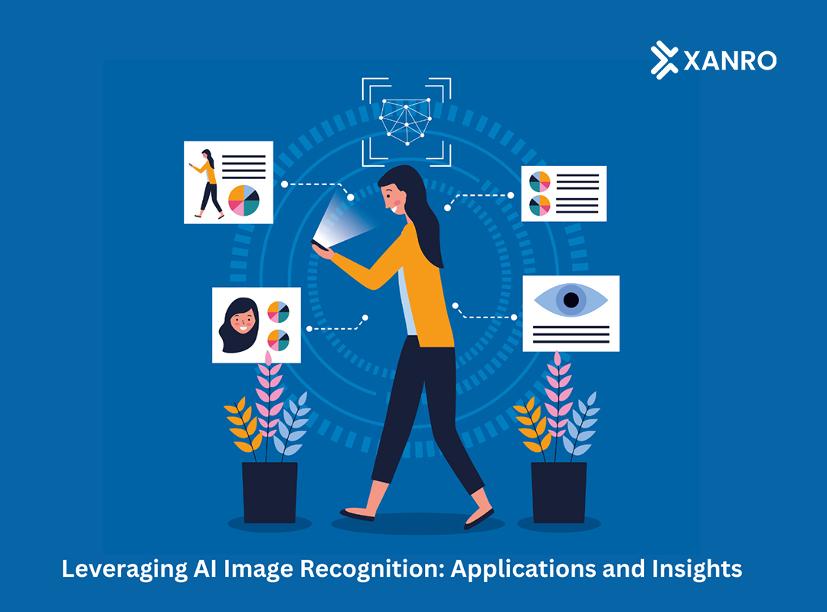
What is AI Image Recognition?
When humans observe an object or scene, our brains naturally distinguish various elements and associate them with specific definitions. This ability for visual recognition is an intricate task for machines, requiring substantial processing power. AI-based image recognition addresses this challenge.
AI image recognition is a technology that utilizes artificial intelligence (AI) to identify written characters, human faces, objects, and other forms of information within images. The accuracy is greatly enhanced when AI learns from a vast array of images. Image recognition is a subset of pattern recognition, a technology that identifies meaningful objects in different data types, like pictures and voice.
In essence, AI Image Recognition represents the technology that empowers machines to decode visual information. It drives automation, facilitates data extraction, and enhances decision-making across a broad spectrum of applications, thereby revolutionizing industries and elevating our interaction with the digital and physical realms.

How Does Image Recognition Work?
Although it comes naturally to the brains of animals and humans, image recognition poses difficulties for computers. The method chosen for image processing relies on the particular use case and includes deep learning and machine learning models. Deep learning techniques, for instance, are frequently used for more difficult issues, like assuring worker safety in industrial automation or finding cancer through medical research.
Image recognition typically involves the creation of deep neural networks that analyze each image at the pixel level. These networks are trained by exposing them to as many labeled images as possible, allowing them to learn to recognize related images effectively.
The image recognition method will involve the three fundamental steps listed below.
Data Collection: Gather a labeled dataset containing images and corresponding labels (e.g., "dog").
Neural Network Training: Employ deep neural networks, such as Convolutional Neural Networks (CNNs), to analyze images pixel by pixel. These networks automatically learn to recognize features. Training involves feeding them labeled images, allowing them to identify patterns and elements.
Inference: Once trained, the neural network can recognize objects in new images. When an unseen image is input, the network processes it and makes predictions based on its training.
This neural network-based approach outperforms traditional computer vision methods, often requiring complex manual engineering and lacking adaptability across various scenarios.
Image Recognition & Object Detection: What is the Difference?
Image recognition and object detection are related to computer vision, but they each have distinct differences.
Aspect | Image Recognition | Object Detection |
Definition | Identifies and categorizes objects or elements within images or videos. | Identifies and locates individual objects within images, often using bounding boxes. |
Complexity | Relatively more straightforward, focusing on categorization without detailed spatial information. | More intricate, involving identification, localization, and size determination. |
Output | Assign a single label or category to the entire image or video | Provides specific spatial information about each object's precise location. |
To illustrate the difference, consider a photograph of a soccer game:
Image Recognition: It would return a single label like "soccer game" for the entire image.
Object Detection: In contrast, object detection would provide multiple labels for players, the soccer ball, and the goal, along with precise positions via bounding boxes.
Understanding these distinctions is crucial when choosing the appropriate technique for specific computer vision tasks, whether categorizing entire images or precisely locating and classifying individual objects.

Typical Applications for AI-based Image Recognition
With its ability to interpret visual data and identify objects, AI Image Recognition has ushered in a new era of technological innovation. These most significant and impactful models of AI Image Recognition offer a glimpse into this technology's versatile and transformative nature.
Facial Recognition
Facial recognition is a widely recognized and extensively used application of AI Image Recognition. It uses AI algorithms to identify individuals from digital images or video streams. This technology maps facial features and compares them to a database of known faces. Facial recognition has diverse applications in social media, security systems, and entertainment. It can also extend its capabilities to identify individuals even when wearing masks, which has become particularly relevant during the COVID-19 pandemic.
Medical Diagnosis
AI Image Recognition plays a pivotal role in healthcare by assisting medical professionals in diagnosing diseases and conditions. It enables the analysis of medical imaging data, such as CT scans and MRIs, to detect abnormalities and provide early-stage disease identification. This technology has applications in radiology, ophthalmology, and pathology, significantly improving diagnostic accuracy and patient care.
Optical Character Recognition (OCR)
Optical Character Recognition (OCR) is an essential application of AI-based Image Recognition. It converts scanned text or handwritten content into machine-readable text. AI-based OCR algorithms enable character and word recognition within images. OCR technology finds use in digitizing printed documents, automating data entry, and making vast amounts of textual data accessible for analysis.

Fraud Detection
Image Recognition enhances fraud detection across various industries, including finance, insurance, and retail. By analyzing images and videos, it identifies suspicious or fraudulent activities. For instance, it can scrutinize credit card transactions, assess the authenticity of signatures, or validate insurance claims based on image data. This application aids in reducing financial losses due to fraudulent activities.
Visual Search
Users can search for information based on photographs or visual attributes using visual search, which AI Image Recognition enables. Google Lens, for example, provides image-based investigations, and Google Translate can instantaneously translate text from photos. These developments would allow users to do real-time searches, making information more accessible and actionable in various settings.
Conclusion
With its remarkable ability to decipher, categorize, and even predict, AI Image Recognition is poised to reshape industries, from healthcare to security and beyond. As the frontiers of image recognition and object detection continue to expand, the applications of these technologies are boundless.
For those looking to harness the potential of AI Image Recognition, Xanro is here with tailored solutions. Our services cover a broad range, including image recognition, object detection for industrial automation, and AI-driven content moderation.
Unlock this potential today and embrace a future shaped by AI Image Recognition.